Have you been working from your sofa for six months and feel guilty every time you want to go work somewhere else? As if leaving your flat meant you were working less well, or less seriously. Spoiler: that's not true. Your employer pays you for your results, not for your presence in your living room. And the law doesn't require you to work from your living room: your remote work agreement or charter sets the places you can work from. Here's what you need to know to work outside your home without any hang-ups.
What your employment contract actually says
Most remote working contracts specify a remote work address, often your home. But unless there's an explicit clause forbidding you from working from another location, you're not chained to your flat. What your employer is buying is your time and your deliverables, not the four walls around you.
French law doesn't require you to stay at home to work remotely. The labour code defines remote work as work organised outside the company's premises, full stop. A café with Wi-Fi, a coworking space, a community space: all of that falls under "outside the company's premises".
If you want peace of mind, re-read your contract and your remote work amendment. If nothing explicitly forbids working from a third-party location, you have some leeway. One practical point: in France, the presumption of a workplace accident applies at the agreed remote work location, so it's better if your employer knows where you work. And if you want to be absolutely sure, ask your HR or your manager directly. Transparency is always better than silent guilt.
Working alone at home isn't trivial
The isolation that comes with remote work doesn't get talked about enough. At first it's nice, no commute, no noisy open-plan office. Then the weeks go by and you realise you haven't seen a human face all day for several days. The boundaries between work and personal life blur. You end up working in the evening because "you're already home anyway".
Studies on workplace wellbeing regularly show that prolonged isolation among remote workers affects motivation, creativity and mental health. It's not a matter of willpower or personal organisation. It's human.
Going out to work in a café or coworking space isn't running away from your responsibilities. It's recreating a dose of social stimulation, a change of environment, and a mental separation between work and home. Psychologists call these "transition rituals". You call it a double espresso and a seat by the window.
How to bring it up with your manager
If your charter says nothing, you may not need to ask for permission, but if you want to clarify things with your manager, here's how to approach the subject without over-explaining yourself.
Frame it as a question of organisation and productivity, not as a desire to "get out". "I work better with a change of environment from time to time, I'm thinking about working from a coworking space a few days a week", direct, professional, focused on efficiency.
If your manager is the type who wants to see you on Slack every hour, reassure them about your availability: "I'll be reachable exactly the same as from home." If you have video calls, plan a quiet spot or a booth in a coworking space.
The mistake to avoid: over-explaining or apologising. You're working remotely, you're an adult, you manage your work environment. A reasonable manager will understand.
VPN, security: what you actually need to check
Here's the concrete point nobody wants to address: IT security. If your company has a VPN policy, you need to follow it wherever you work. The public Wi-Fi in a café is an open network. Without a VPN, your data travels in the clear.
Rule one: activate your VPN as soon as you connect to any network that isn't yours. Most companies provide a VPN; otherwise you can use a personal one for everyday use.
Rule two: avoid opening sensitive documents on a large screen in a public place. Not out of paranoia, but out of common sense. Coworking spaces generally offer a more secure environment than cafés: dedicated networks, private spaces available.
Rule three: check whether your company has a remote security policy. If so, read it. If not, common sense covers most situations.
The café and the coworking space: two legitimate options
The café is good for a few hours, a change of scenery, a solo work session on lighter tasks. The atmosphere is pleasant, the coffee is good, and simply being surrounded by other people getting on with their things boosts your concentration, the famous "creative background noise" effect. For calls, long sessions or work on sensitive data, though, it's limited.
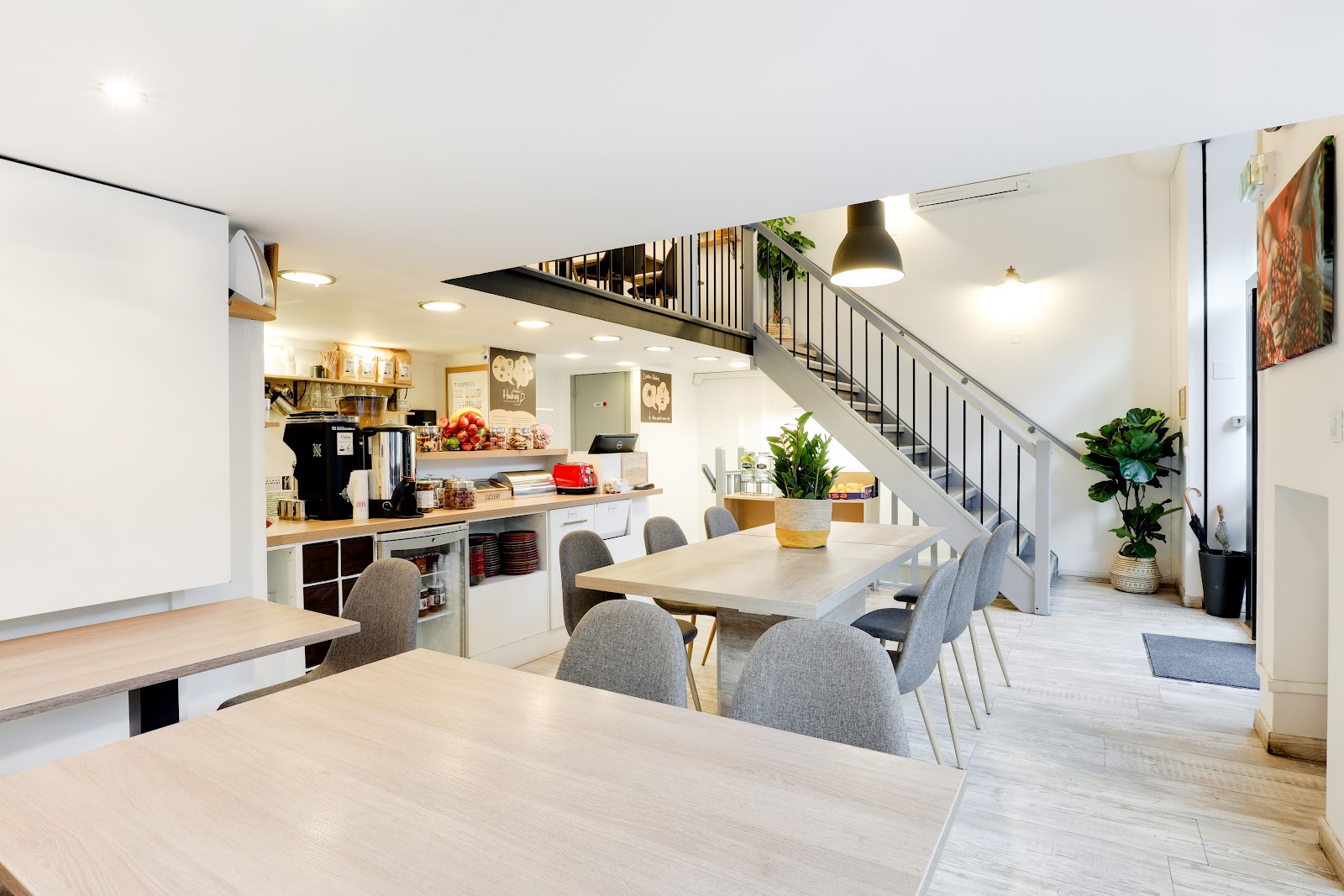
The coworking space is the professional option. Fixed or flexible desk, secure Wi-Fi network, meeting rooms for calls, a community of workers around you. And good news: more and more employers are reimbursing all or part of coworking costs for their remote employees. It's worth asking, some companies even have "remote workspace" budgets set aside for this.
Deskover lists the best laptop-friendly cafés and coworking spaces in France so you can find exactly what you need, wherever you are.
Read also
- Café or coworking space?
- Is café Wi-Fi secure?
- Your first time in a coworking space
- What does a coworking space cost?
Leaving home to work isn't cheating. It's taking care of your mental health, your productivity and your balance. Your employer pays you to work, and you work. It doesn't matter whether it's from your desk, a café or a coworking space in Lyon. Explore spots near you on Deskover and find your next favourite place to work.