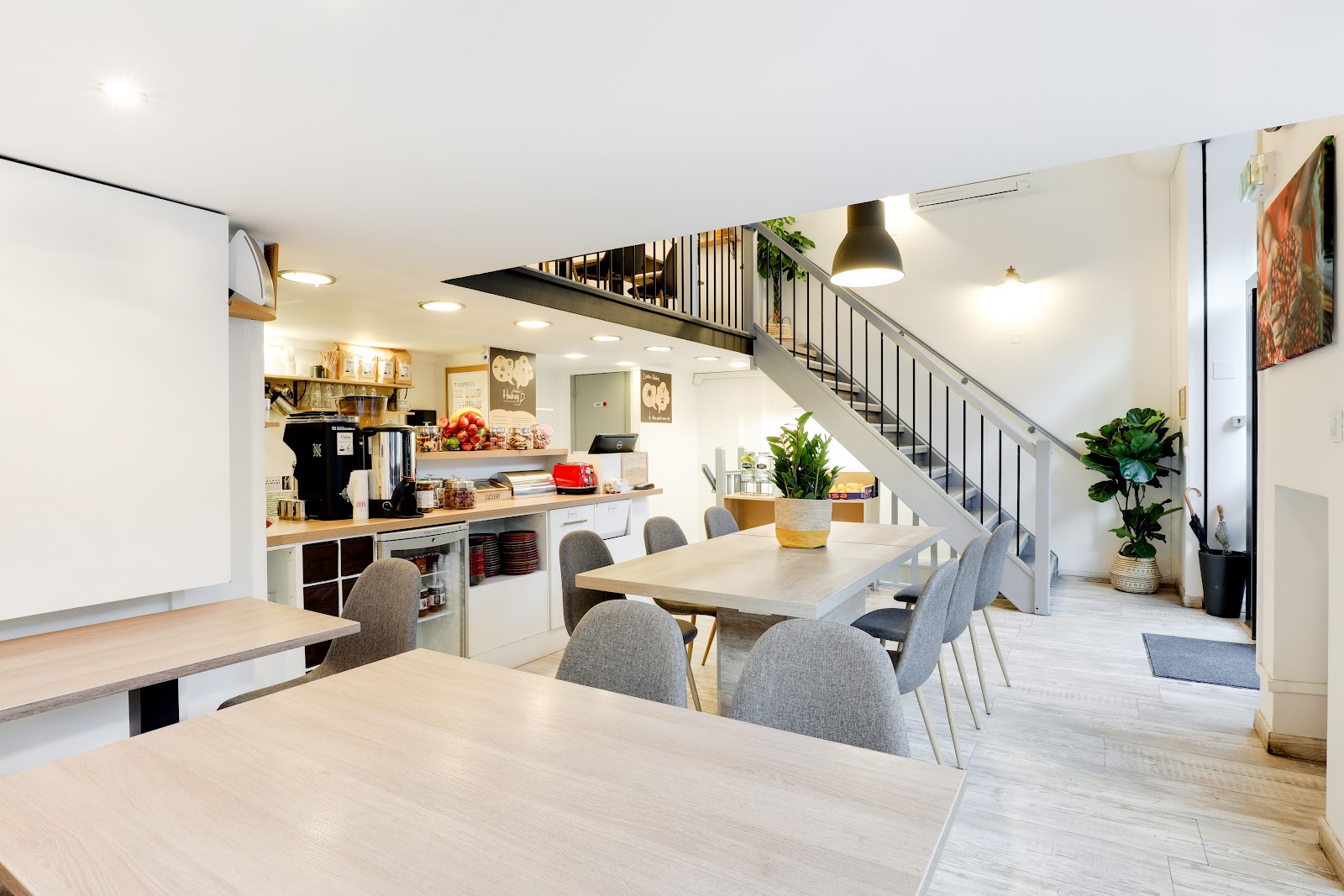
Have you ever noticed that you work better in a busy café than in a silent flat? It's not just in your head (well, it is), but it's real science. There's an ideal noise level for focus and creativity, and spoiler: it's exactly the hum of a good café. Here's why, and how to make the most of it.
The science behind noise: 70 dB, the magic number
Researchers at the University of Illinois nailed it down: ambient noise around 70 decibels improves creativity. That's the sound level of an active café: not too quiet, not too hectic.
The mechanism is counterintuitive. Complete silence, far from helping you concentrate, lets your brain wander. Without any sound stimulus, it goes looking for its own distractions, and it always finds some. On the other hand, noise that's too loud, above 85 dB, saturates working memory and makes complex thinking impossible.
The sweet spot is that diffuse background sound where you can sense voices without making out the words, where there's movement but nothing draws your attention. Your brain is just stimulated enough to stay alert and focused, without being overwhelmed.
The types of background noise that actually work
Not all background noise is created equal. Here's what works and why.
Café chatter (indistinct conversations, cups clinking, low music) remains the classic. It combines varied auditory stimulation with a sense of social presence.
Rain is remarkably effective. Its random yet regular nature creates what's called pink noise, softer than white noise, which masks distracting sounds without assaulting the ears.
Lo-fi music, that slow, slightly crackly instrumental hip-hop, has become the background sound for an entire generation of remote workers. The steady rhythm anchors your attention without lyrics getting in the way of your thinking.
Pure white noise works better for people who are hypersensitive to auditory distractions. It levels everything out, but can become tiring over long sessions.
Apps for simulating the atmosphere: useful, but not magic
When you can't make it to a café, several tools try to recreate the atmosphere.
Coffitivity is the reference: it offers café ambiences recorded in real establishments, with different intensity levels. Simple, effective, free.
Noisli goes further with a customisable sound mixer: rain, forest, café, train, fan. You build your own sonic cocktail depending on your mood and the task.
Brain.fm takes a different approach: AI-generated music designed specifically to induce states of concentration in the brain. Paid, but some users swear by it.
These apps are a good stopgap, but they have a limit: the noise is predictable. Your brain eventually detects it as a uniform background and starts ignoring it. The unpredictability of a real café (a chair scraping, a conversation erupting in laughter, a cup falling) keeps attention active far more effectively.
Choosing the right café: the art of the right noise level
Not all cafés are equal for getting work done. Some concrete criteria for finding your ideal spot.
Avoid peak hours. Between 9 and 11 am, then 2 and 5 pm, you'll find the ideal atmosphere. The café is lively without being chaotic.
Look at the ceilings. Large spaces with high ceilings diffuse sound rather than concentrating it. The buzz stays present but doesn't become deafening. Small spaces with hard surfaces, on the other hand, amplify every sound and quickly overwhelm you.
Test the noise level before sitting down. If you have to raise your voice to place an order, it's too loud. If you can clearly hear the conversation at the next table, it's too quiet.
Laptop-friendly cafés have often calibrated all this instinctively: music at a good volume, enough space between tables, a clientele used to working nomads.
When silence is still the best option
A café isn't the universal answer. Some tasks demand relative quiet.
Deep analytical work (rereading a complex contract, debugging code, modelling a budget) requires maximum working memory. Any noise, even at 70 dB, reduces the capacity available for this kind of effort.
Proofreading and text editing benefit from silence: your inner ear needs to hear what you're reading, and external noise creates interference.
The practical rule: creative tasks and writing in a café, analytical tasks and proofreading in a quieter environment. Many freelancers juggle both in the same day: café in the morning to push projects forward, home or a quiet coworking space in the afternoon for the finishing touches.
Conclusion
Your brain needs a certain level of stimulation to perform at its best. Not sterile silence, not sonic chaos. A good café at the right moment is often the best working infrastructure there is. Explore the spots in your city on Deskover to find the atmosphere that suits you.