You've been working for two hours, you're not moving forward, you're re-reading the same sentence on a loop. That's not a lack of motivation, it's your brain asking for a break. Except a real break doesn't look like scrolling Instagram for three minutes. The science is clear on this, and once you understand why your brain checks out, you'll change the way you work, and probably choose your next work spot differently.
What science says about breaks
Your brain works in cycles. Ultradian rhythms, described notably by researcher Nathaniel Kleitman, suggest that your concentration follows oscillations of roughly 90 minutes. After that threshold, your brain enters a natural recovery phase: you become distracted, irritable, less creative. It's not a failure, it's a protective mechanism.
The Pomodoro method breaks work into 25-minute blocks with 5-minute breaks. Effective for repetitive or admin tasks, it's built on the same principle: alternating effort and recovery rather than pushing through continuously.
In both cases, the break isn't a reward. It's a necessary condition for performance. Studies on cognition show that a short interruption restores attentional resources far better than pushing to exhaustion. Taking a break doesn't cost you time, it buys it back.
How long, and when
For deep work (writing, code, analysis, creative thinking) aim for a break every 90 minutes. That's your brain's natural rhythm; don't fight it. For more mechanical tasks (answering emails, organising files, making calls) the Pomodoro method with a break every 25 minutes is better suited.
The ideal duration: 10 to 15 minutes. That's enough for your prefrontal cortex to recover, but not so long that you lose the thread of what you were doing. Under 5 minutes, the recovery is incomplete. Beyond 20 minutes without a clear intention, you risk settling into a different mental state and losing the momentum to start again.
Schedule your breaks in your calendar if you need to. But over time, your body will signal them naturally, yawns, a blank stare, the urge to stand up for no reason. Those are signals to respect, not to override with another coffee.
What you do during the break (and what to avoid)
A real break means cutting off the flow of stimulation. Walking for a few minutes (even down a corridor or around the block) lets your mind wander, which helps idea integration and diffuse creativity. Many good ideas arrive while walking, not while staring at a screen.
What to definitely avoid: checking your emails, opening a news feed, watching short videos. Scrolling is the illusion of a break, your brain stays in information-processing mode, it doesn't recover. You come back just as tired as before, sometimes more so.
Other effective options: slow breathing (4 counts in, 4 counts out), looking out the window, chatting about nothing with someone, doing a few stretches. The core idea: disengage voluntary attention and let your brain idle.
The advantage of a café as a workspace
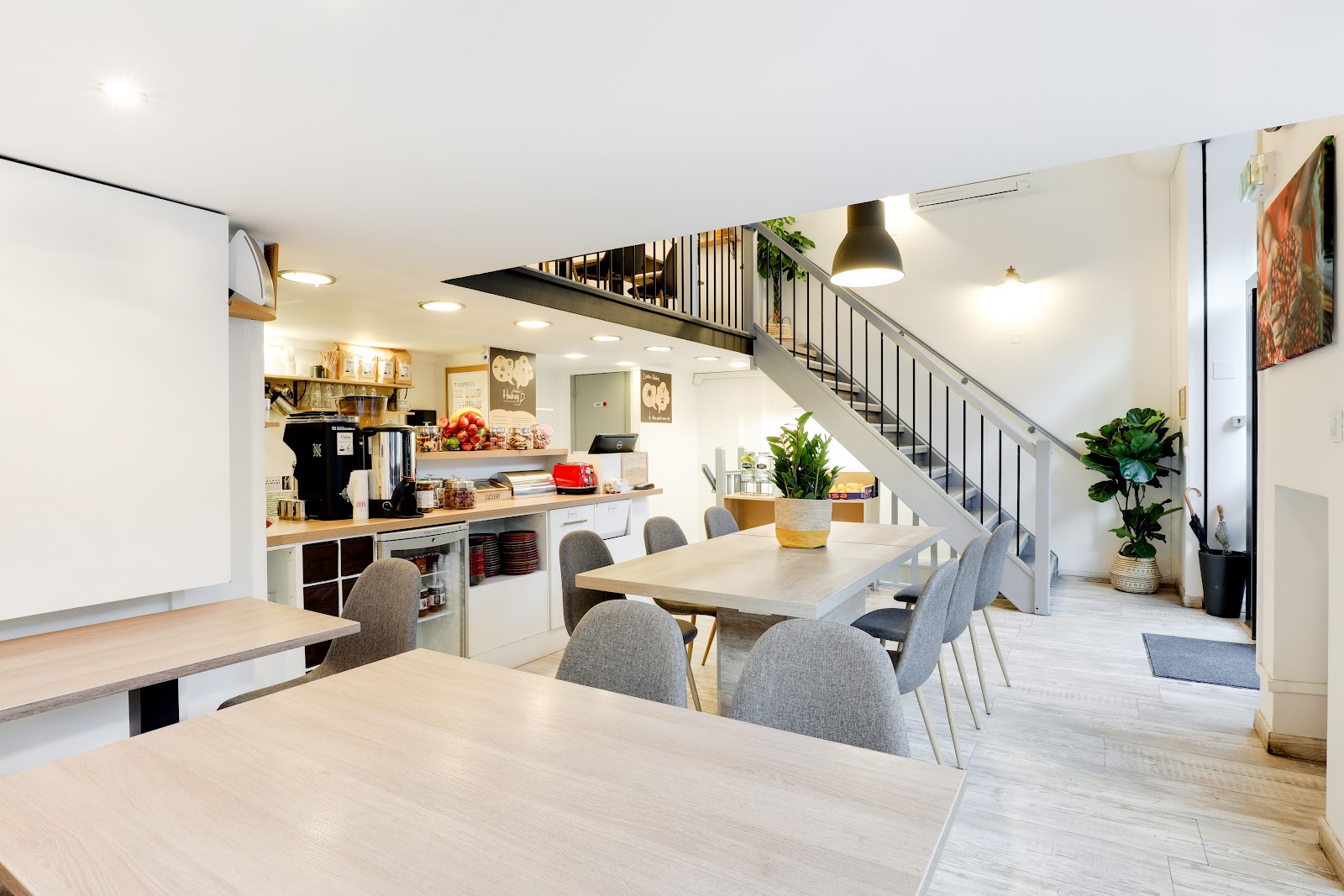
In a well-chosen café, the break is built into the environment. Ordering a drink forces you to stand up, briefly interact, change your physical context, exactly what your brain is asking for. You don't need to convince yourself to take a break: it's built into the place.
There's also the effect of shared space. Seeing other people working around you normalises natural breaks. You don't feel the same guilty relationship with stopping for five minutes as you do when you're alone in a home office, under the silent pressure to "always be productive".
Choosing a café with good flow (natural light, moderate background noise, room to move) is optimising your work environment so that breaks happen naturally and actually do their job.
Getting back to it without losing the thread
Real productivity doesn't look like an uninterrupted sprint. It looks like a series of intense phases interspersed with genuine recovery. A well-taken break brings you back to your work with more clarity, more energy, and often a perspective you didn't have before you stopped.
So the next time things feel stuck, put your laptop down. Stand up. Walk a little. Order a coffee. Your brain isn't failing, it's just asking for what it needs.